
The AI bubble is in the financing, and the technology underneath will outlive it
AI usage is real. The fragile part is the debt-funded infrastructure layer behind models, chips and data centers.

Agentic AI
Most AI agents fail because the work is too broad, the data is weak, and governance arrives too late.
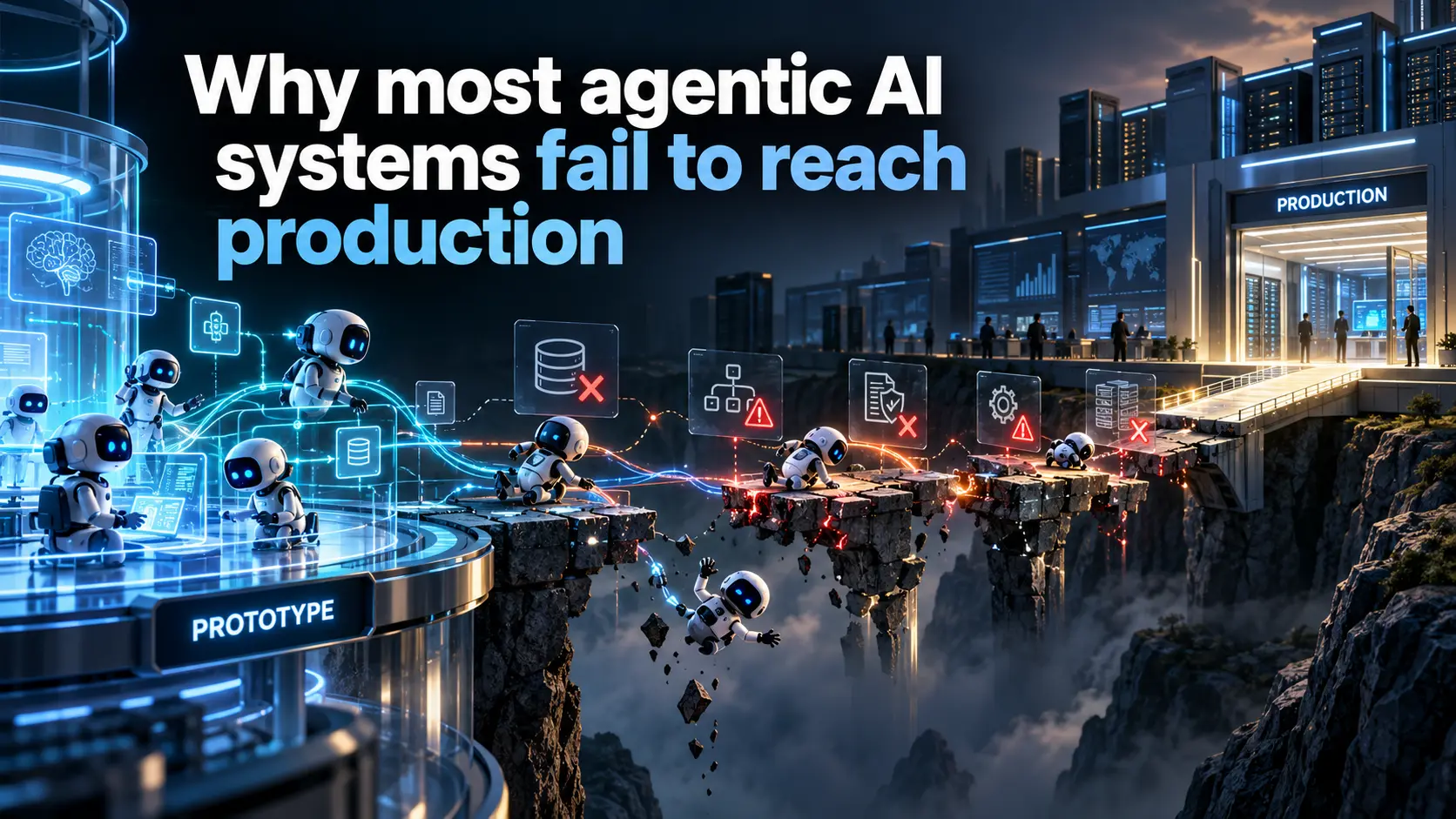
Most agentic AI systems fail to reach production because they start as impressive demos, not working business systems. They are given broad goals, weak data access, unclear permissions, and no real owner. Production needs a narrow workflow, controlled actions, and people who know when to trust the agent and when to step in.
Agentic AI fails when it is asked to solve a whole department’s problem in one step. A broad goal like “improve sales productivity” or “automate compliance” sounds useful, but it gives the agent too many paths and too little control.
A production use case needs a narrow workflow. For example, an agent can review inbound support tickets, classify the issue, check the customer record, draft a reply, and escalate high-risk cases. That is bounded work. It has a clear input, a known set of tools, and a human owner.
The business outcome also has to be measurable. The metric could be faster first response, fewer manual checks, or shorter case handling time. Without that, the project becomes a technology trial with no clear reason to survive budget review.
We usually start by finding these narrow workflows through an AI and Growth Diagnostic. The first question is simple: what decision or action should the agent improve?
Agents break in production when they cannot reach the systems they need. A demo can run on sample files. A live agent needs approved tools, current data, and rules for what it can do.
Context matters as much as access. If the agent is answering a finance, risk, or customer question, it needs reliable retrieval. Retrieval means it can pull the right policy, contract, ticket, transaction, or knowledge base article before it acts. If retrieval is weak, the agent may sound confident while using old or incomplete information.
Human controls are also part of the system. Some actions can be automatic. Others need review. A useful design says which actions the agent can complete, which ones need approval, and when it must escalate to a person.
Audit trails matter here. The system should record what data was used, what action was proposed, who approved it, and what happened next. Our work on AI agents and automation treats these controls as core build requirements, not extras.
Governance fails when it is added after the pilot works. By then, the agent may already rely on data flows, prompts, tools, and permissions that security, legal, or compliance teams cannot approve.
CIOs, CDOs, and CISOs need to define the rules from day one. The rules should cover what data the agent can use, which tools it can call, what it can write back to systems, and what logs must be kept. They should also define risk levels. A low-risk content draft does not need the same control as a claims decision, payment action, or customer eligibility recommendation.
Good governance also makes delivery faster. Teams stop guessing what is allowed. Engineers can build inside known guardrails. Business owners know which approvals are needed before launch.
At Burraq Quantum, we connect AI strategy with governance early through AI strategy and governance. The aim is to make the agent usable in the real operating environment, not just acceptable in a slide deck.
A working demo does not mean people will use the agent. Production changes how work gets done. If the team does not trust the agent, does not understand its limits, or sees it as extra work, adoption will stall.
Change management starts with the workflow. Who receives the agent’s output? Who checks it? Who is accountable if the agent suggests the wrong action? What happens when the system is down or unsure? These questions sound basic, but they decide whether the agent becomes part of daily work.
Training also has to be practical. Teams need to know how to write useful instructions, read the agent’s evidence, spot weak answers, and escalate edge cases. Managers need new measures for quality and speed. Support after launch is needed because real users will find gaps that the pilot did not show.
This is where AI training for teams helps. The goal is not to teach abstract AI theory. It is to help people use the agent safely inside their actual jobs.
If an agentic AI project is stuck in pilot, check the basics first. Is the workflow narrow? Does the agent have approved access and reliable context? Are permissions, logs, and escalation paths clear? Does the operating team know how to use it?
If you want a structured review, start with the diagnostic on the contact page. We use it to find the first production-ready workflow and the controls needed around it.

Questions
Agentic AI is software that can plan steps, use tools, retrieve information, and take actions within set limits.
For example, a sales agent could read a new inbound lead, check the CRM, find the right case study, draft a reply, and create a follow-up task. It is different from a simple chatbot because it does not only answer a question. It works through a defined workflow with approved tools, data access, and human review where needed.
The use case is often too broad. Production needs a narrow workflow with a clear owner, data access, controls, and a measurable outcome.
For example, “improve sales productivity” is too wide. “Review inbound demo requests, enrich the account, score fit, draft the first reply, and route high-fit leads to a rep” is a production workflow. It has known inputs, approved actions, and a person who can review exceptions.
A business owner should own the workflow, with CIO, CDO, CISO, and engineering teams setting access, risk, and operating controls.
Governance should be added at the start. Data access, tool permissions, logs, approvals, escalation paths, and compliance rules shape how the agent is designed and built.
Train users on the workflow, the agent’s limits, review steps, and escalation paths. Then support the team as real cases expose gaps.
AI usage is real. The fragile part is the debt-funded infrastructure layer behind models, chips and data centers.
Agentic RAG survives production when retrieval, cost controls and permissions are designed before the agent is deployed.
Enterprise demand teams need governed agentic loops, not more AI content tools. The shift starts with data, verification, and new operating pods.
Define the workflow before writing the job ad, then vet AI engineers on systems they have put into daily use, since integration is where rollouts stall.
Measure AI adoption by usage and depth, then measure impact task by task against a baseline recorded before rollout.
Train employees on AI using their own daily tasks, clear rules on what is allowed, and a check on whether work changed. General courses rarely stick.
An AI readiness assessment checks your data, systems, people, rules and candidate uses, then ranks what to do first.
Start here
A 30-minute call to see whether we can really move your numbers. You leave with a clear next step, even if we never work together.

The diagnostic
Tell us what you want to achieve and where things stand today. We read every message ourselves and reply within two working days.
Q