Surviving Production: Agentic RAG and Edge Inference Costs
Agentic RAG survives production when retrieval, cost controls and permissions are designed before the agent is deployed.

Agentic AI
AI usage is real. The fragile part is the debt-funded infrastructure layer behind models, chips and data centers.

On 8 October, OpenAI told its investors that its annualised revenue was about $50 billion. The figure that had been doing the rounds was $68 billion.
That is a lot of rounding.
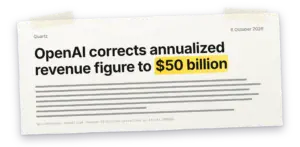
Nvidia, Oracle and CoreWeave fell the same day. Within six sessions the Philadelphia semiconductor index had shed $1.6 trillion of value. On 22 October, Meta beat its revenue estimates, raised the floor of its capex guidance to $135 billion, and still fell about 7%, helping drag the Nasdaq to its worst day since June.
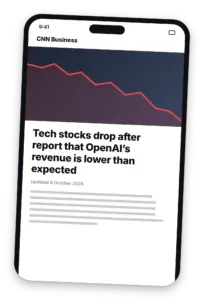
So the bubble people are back on television, the boom people are back on LinkedIn, and both are mostly arguing about share prices. (I build AI products for a living, so feel free to discount my optimism accordingly.) The more useful question is who is paying for this boom, and who pays if it breaks. The list includes a lot of people who have never bought a GPU.
The third is where the damage would start. It is also where it would spread from.
In October 2025, OpenAI agreed to buy six gigawatts of AMD’s GPUs. As part of the deal, AMD gave OpenAI warrants for up to 160 million AMD shares, vesting as OpenAI deploys the chips and as AMD’s share price hits agreed targets.
Read that slowly. The customer is paid in the supplier’s stock for buying from the supplier, and that stock is worth more if the market believes the customer will keep buying. It’s a restaurant paying you in restaurant shares to eat there, with a bonus if the shares rise because people saw you eating there.
Nvidia’s version is quieter. It sells chips to CoreWeave, owns a stake in CoreWeave, and has agreed to buy any CoreWeave capacity nobody else wants, all the way to April 2032. When a supplier guarantees its own customer’s demand, that demand looks sturdier than it is.
CoreWeave carries about $50 billion of debt against roughly $13 billion of expected revenue this year. In mid-October its credit default swaps implied about a 63% chance of default within five years, double the odds of a year earlier, and its April bonds were trading at 79 cents on the dollar.
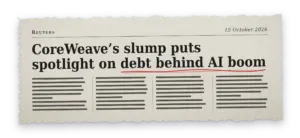
A GPU is state of the art for two, maybe three years. The building around it, and much of the debt that paid for both, lasts far longer. Funding AI chips with long-dated debt is a bit like taking a fifteen-year loan on a smartphone. It works fine for as long as someone keeps paying you rent on the phone.
Gartner now says about 80% of these GPU-rental “neoclouds” could shut down by 2030. Gartner has been wrong before. Bond markets have too, though less often, and right now they agree with Gartner.
Bubbles are usually discussed as if the only people exposed are the ones holding the shares. This one sends invoices to people who don’t.
Start with memory. Chipmakers have moved capacity to the high-bandwidth memory that AI servers need, and conventional DRAM prices rose 55% to 60% in a single quarter around the turn of the year. In India, average smartphone prices rose 16% in the first half of 2026, according to Counterpoint. IDC says shipments of phones under $100 fell 74% year on year in the second quarter. The cheapest phones in the country are quietly disappearing, partly because the memory that went into them is now in AI servers on another continent.

None of this appears on anyone’s AI capex slide.
Then power. On PJM, the grid that serves 13 US states and Washington DC, capacity costs hit a record $16.4 billion for 2027 to 2028, and almost all of the projected growth in peak demand comes from data centres. Some households there are seeing bills rise 1.5% to 5% this year, and NRDC projects an extra $70 a month for an average family by 2028. Closer to home, Telangana is offering data centres power at generation cost and “continuous water supply” for cooling, in the same month Hyderabad is running a 150 MGD water deficit.

Announced tech layoffs reached 196,349 this year as of 23 October, according to TrueUp. Amazon has announced around 16,800 cuts, Meta around 8,700, Microsoft around 4,800. Meta cut staff in the same year it raised capex to as much as $145 billion.
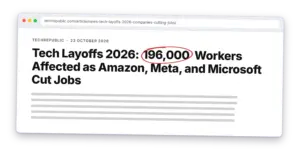
Companies rarely say “we’re letting you go so we can buy GPUs”, and only about a quarter of the layoff announcements that gave a reason mentioned AI at all. But the capex has to be paid for from somewhere, and payroll is the line a CFO can move fastest. (I’m aware that’s a cynical reading. I’ve also sat in budget meetings.)
The data centres don’t hire many people back. A large one employs somewhere between 50 and 300 people once it’s running. The construction crews move on to the next site, and while they’re there they’re competing with every other project in the region for electricians. And the squeeze lands hardest at the entry level, where firms are hiring fewer juniors because AI now does junior work.
This build-out is happening during a war. The Strait of Hormuz has been effectively closed to commercial traffic since late February. Brent was around $114 this week, and India paid an extra $22.5 billion for fuel imports between March and August. Iranian strikes took Qatar’s Ras Laffan complex offline in March, and with it about a third of the world’s helium, which chip fabs use to cool EUV lithography machines. Helium prices have risen 40% to 100%.

Against that backdrop, ING estimates AI investment accounts for roughly a third of US GDP growth this year, offsetting the drag from the energy crunch. So if the AI financing layer cracks, it will crack in an economy that is already absorbing an oil shock. That combination is the scenario I’d actually lose sleep over.
The race framing also changes how any bust would play out. Governments now treat AI as strategic. Chips have been under US export controls for years, and in June a US export-control directive forced Anthropic to switch off two of its frontier models for every customer for close to three weeks. Gulf states are being pressed to choose between American and Chinese technology stacks, and the war is pushing them to hedge with both. Washington took roughly 10% of Intel in 2025. In November 2025, OpenAI’s CFO spoke publicly about a government “backstop” for chip financing, before the company walked the remark back.

When something is declared strategic, governments rarely let it fail tidily.
In the late 1990s, telecom carriers borrowed heavily to lay fibre on the belief that internet traffic was doubling every 100 days. Andrew Odlyzko, then at AT&T Labs, measured it and found growth of 75% to 150% a year. That was extraordinary growth. It just wasn’t the growth they had borrowed against. By mid-2002, the FDIC estimated that only 2% to 5% of US fibre was lit, telecom made up about a quarter of all corporate bond defaults by value, and Global Crossing and WorldCom had gone under. A decade later, that same fibre carried YouTube, Netflix and most of the cloud.
Nobody bailed out Global Crossing. The lenders took the loss, and everyone after them got cheap bandwidth. This time the losses are more likely to be spread around: some to lenders, some to taxpayers, and some to ordinary people through the price of phones, power and jobs. The infrastructure will still survive.
The bill just gets posted to more addresses.
If you buy AI rather than build it, a repricing in the financing layer would mostly help you. Compute gets cheaper and models get commoditised.
The catch is vendor mortality. Many AI products are thin layers on rented GPUs, funded by investors who assumed the money would keep arriving. Some of the tools you sign up for this year won’t exist in 2028, and your workflows and data will be inside them when they go.
India is exposed in quieter ways too: through electronics prices, through an oil bill the war has already inflated, and through US technology budgets that pay for Indian IT services and GCC hiring. Google’s $15 billion AI hub is going up in Visakhapatnam and Telangana wants 8 to 10 gigawatts of data centres, so we are inside this build-out with everyone else.
Within 18 months, at least one major neocloud or data-centre financing vehicle will restructure its debt, get absorbed by a larger player, or renegotiate its tenant contracts. Given everything above, I now think there’s a fair chance a government helps arrange it. Meanwhile, AI usage will keep rising and the price of AI output will keep falling, while memory and power stay expensive for the rest of us.
I’ll be wrong if neocloud debt gets refinanced at investment-grade rates, if AI revenue keeps pace with capex through 2027, or if memory and electricity prices fall back during 2027. I’ll come back to this in April 2028 and say which it was.
If you’re signing an AI contract this quarter, ask the vendor three questions. Who pays for your GPUs? What happens to my data if you stop operating? Can I leave within 90 days? And if you’re approving a data centre in Telangana, ask the developer how much water and power it will draw in May, and get the answer in writing.
This is analysis, not investment advice.
Clippings reproduce each outlet’s published headline and date for commentary. Layouts are illustrative and do not use the outlets’ own designs or logos.

Questions
The question is too broad. AI usage is real, but parts of the infrastructure financing layer look fragile.
The risk sits in neocloud debt, project financing and supplier-backed demand, where long-term loans may depend on short-lived chips and a few customers.
Not necessarily. It could make compute cheaper and models more available. The main buyer risk is choosing a vendor that does not survive.
Keep terms short where possible, make data portable, check model dependencies and prepare an open-weight fallback.
Neocloud debt refinancing at investment-grade rates, AI revenue keeping pace with capex through 2027 and model-company margins improving.
Questions
Yes. The article argues that usage and paid demand are real. The risk sits more in how the infrastructure is financed.
It could start in the financing layer. Neoclouds borrow against chips that age fast, and their demand rests on a few big tenants. If one pulls back, the loans still come due.
Because a correction could lower your costs and close your vendor in the same year. Cheaper compute helps, but a vendor that borrowed heavily may shut down or change its terms. Before you sign, ask how you get your data out and how long the vendor can last without new funding.
Ask who pays for the GPUs, what happens to your data if the vendor stops operating, and whether you can leave within 90 days.
No. It says AI usage can keep rising while parts of the build-out are restructured or absorbed. The weak point is debt that can outlast the chips it paid for, so a lender may take a loss while the technology carries on.
Agentic RAG survives production when retrieval, cost controls and permissions are designed before the agent is deployed.
Enterprise demand teams need governed agentic loops, not more AI content tools. The shift starts with data, verification, and new operating pods.
Most AI agents fail because the work is too broad, the data is weak, and governance arrives too late.
Define the workflow before writing the job ad, then vet AI engineers on systems they have put into daily use, since integration is where rollouts stall.
The best time to hire a strategy consultant is just before a decision that is hard to undo, with an owner inside ready to act on the evidence.
Measure AI adoption by usage and depth, then measure impact task by task against a baseline recorded before rollout.
Train employees on AI using their own daily tasks, clear rules on what is allowed, and a check on whether work changed. General courses rarely stick.
Start here
A 30-minute call to see whether we can really move your numbers. You leave with a clear next step, even if we never work together.

The diagnostic
Tell us what you want to achieve and where things stand today. We read every message ourselves and reply within two working days.
Q